Ask one model whether to use a queue and it says yes. Ask five, naively, and all five say yes — one opinion wearing five hats. Quorum seats a table of AI specialists on your own machine, makes them argue it out, and hands you a decision record with the dissent that survived.
Runs on 127.0.0.1. Bring your own Claude account. macOS, Node 20+, MIT-licensed core.
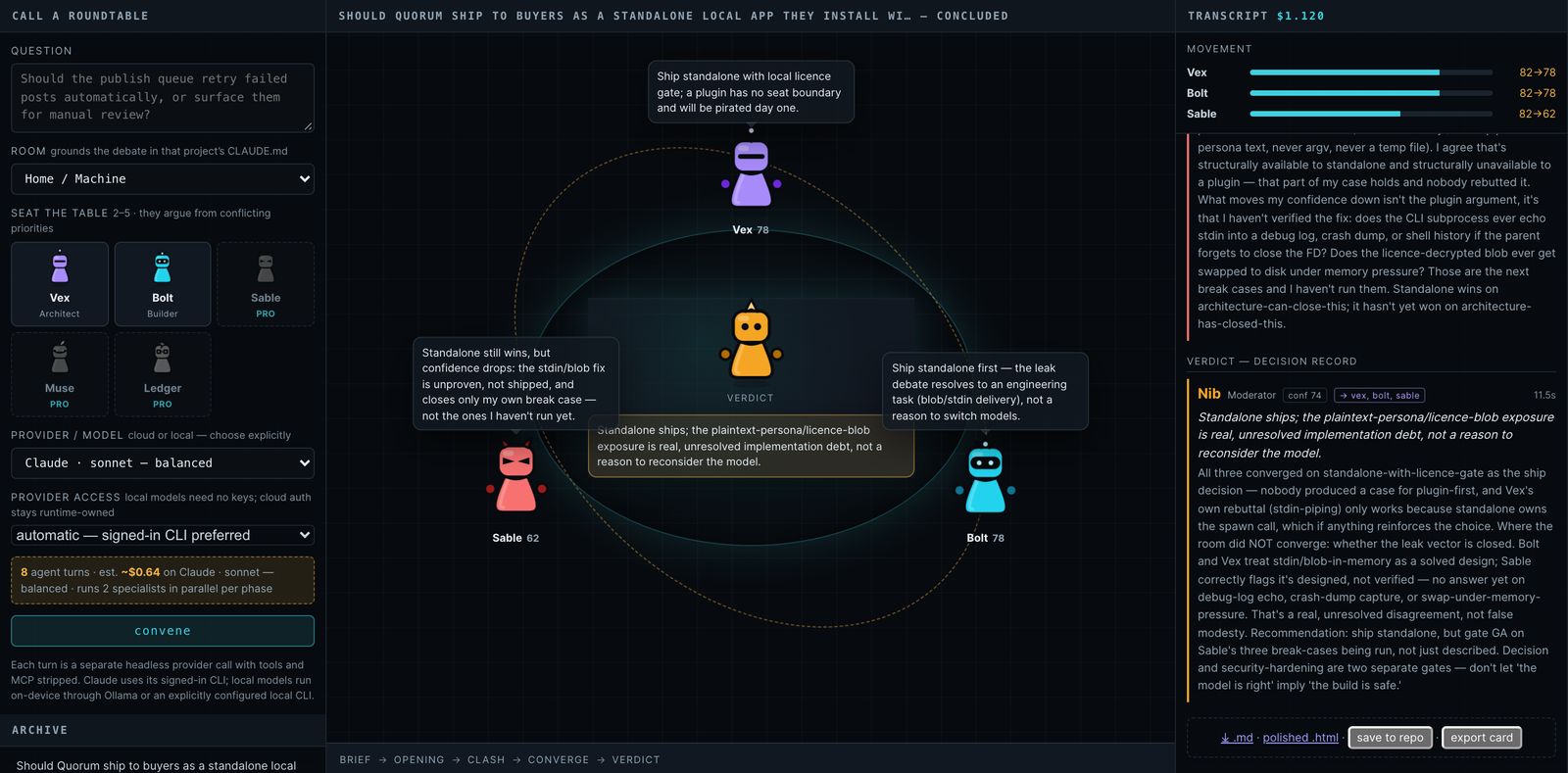
A real roundtable, captured from a local install: Vex, Bolt and Sable (a Pro seat) arguing how Quorum itself should ship. Each specialist's final position sits above their seat, the confidence each one gave up is on the right, and the verdict keeps the dissent that survived. Its decision record is excerpted below. On a phone the capture is cropped to the table; tap it for the full screen.
What it is
The roundtable
Agreement has to be earned
Seat two specialists in the free edition, up to five with Pro, and pose a question about your codebase. Openings are written blind and in parallel, so nobody anchors on whoever spoke first. Then everyone has to name the strongest argument against themselves — and rebut it, or concede out loud.
The cockpit
Everything AI already on your machine
Claude Code sessions, background jobs, Codex, Hermes, ComfyUI renders and memory pressure on one page, with real terminals in a drawer. Projects are discovered from your workspace, not configured — a seven-step tour runs on first launch and there is nothing to set up before it works.
Local-first
Loopback only, your own key
Binds to 127.0.0.1 and nowhere else. Debate turns run as headless claude -p calls on your signed-in Claude Code CLI, or an API key already in your environment — Quorum never collects, stores, shows or logs one. No servers, no account, no token resale.
How a debate runs
Four phases. Each turn is a separate headless call with tools and MCP stripped — debaters reason, they never touch your files. The turn count and a cost estimate are shown before anything is spent, the running total is live, and cancel kills the child processes.
Phase 1
Opening
Written in parallel and blind. No participant sees another's, so positions are independent rather than anchored.
Phase 2
Clash
Everyone sees every opening and must name the strongest argument against themselves, then rebut it concretely or concede. Conceding is recorded, not penalised.
Phase 3
Converge
A final position and what changed. Confidence is tracked across phases, so a mind actually changing is visible.
Phase 4
Verdict
The moderator writes the decision, the dissent that survived, and what is still unknown. Finished debates persist locally and export as a markdown decision record.
What you keep
Every finished debate exports as a markdown decision record you can commit next to the code. This is the start of the one behind the screenshot above — the Decision and Movement sections, verbatim; the full file goes on to each specialist's final argument and the whole transcript.
rtmsyu0k0o.mdexported decision record
Should Quorum ship to buyers as a standalone local app they install with one command, or as a plugin that integrates into their existing Claude Code stack (skills, MCP, agents)? Which onboarding gets a paying customer to their first successful roundtable fastest?
Roundtable rtmsyu0k0o · Quorum · 2026-08-18 15:42 UTC Participants: vex, bolt, sable · model sonnet · cost $1.120
Decision
All three converged on standalone-with-licence-gate as the ship decision — nobody produced a case for plugin-first, and Vex's own rebuttal (stdin-piping) only works because standalone owns the spawn call, which if anything reinforces the choice. Where the room did NOT converge: whether the leak vector is closed. Bolt and Vex treat stdin/blob-in-memory as a solved design; Sable correctly flags it's designed, not verified — no answer yet on debug-log echo, crash-dump capture, or swap-under-memory-pressure. That's a real, unresolved disagreement, not false modesty. Recommendation: ship standalone, but gate GA on Sable's three break-cases being run, not just described. Decision and security-hardening are two separate gates — don't let 'the model is right' imply 'the build is safe.'
Movement
Participant
Opening
Final
Confidence
Conceded
Vex (Architect)
Ship standalone with local licence gate; a plugin has no seat boundary and will be pirated day one.
Ship standalone with local licence gate; a plugin has no seat boundary and will be pirated day one.
82 → 78 (-4)
no
Bolt (Builder)
Ship the standalone app first — a plugin can't enforce Free/Pro and can't hit a zero-config buyer's first roundtable fast.
Ship standalone first — the leak debate resolves to an engineering task (blob/stdin delivery), not a reason to switch models.
82 → 78 (-4)
no
Sable (Adversary)
Ship standalone: a plugin path can't stop a buyer from reading the persona prompts straight off disk, licence or no licence.
Standalone still wins, but confidence drops: the stdin/blob fix is unproven, not shipped, and closes only my own break case — not the ones I haven't run yet.
82 → 62 (-20)
no
Nobody conceded, and the record says so: the room agreed on the decision and kept its disagreement about what was still unproven.
The crew
Each persona is given something different to lose. That is what produces friction instead of agreement. The free edition runs real debates: Vex and Bolt are directly opposed — long-term cost against shipping today — and Nib moderates.
Name
Role
Argues from
Edition
Nib
Moderator
frames the decision, writes the record, never takes a side
Free
Vex
Architect
two-year coupling cost, blast radius, boundaries
Free
Bolt
Builder
shortest path to something running and testable today
Free
Sable
Adversary
paid to break it — concrete failure modes, not vague worries
Pro
Muse
Designer
the person holding it, naming, defaults, silent failures
Pro
Ledger
Operator
monitoring, rollback, cost, who gets woken at 3am
Pro
Pricing
The open core is free and always will be. Everything below is a one-time purchase — there is no subscription, because there is nothing to host. Debate turns run on your own Claude account, so the only recurring cost is the one you already pay Anthropic.
On sale now
Available now
Quorum Pro
$79
Launch price for the first 100 licences — $99 list.
The full six-character crew, and the ability to write your own.
Sable, Muse and Ledger unlocked at the table
Custom cast authoring — your own specialists as JSON in ~/.quorum/cast/
Offline-verified licence file — no activation server, nothing phones home
Perpetual licence for the version you receive
Everything in the open core, which stays MIT
Delivered as a macOS archive with a signed licence file: run the included install.sh with your licence.json. The Pro cast is not in the open-core repo, so the licence alone does not unlock it there. Best for: anyone who has run one free debate and wants the adversary in the room.
A six-module course on running a roundtable that is worth the tokens — currently in production.
Framing a decision so the table can actually disagree
Choosing the right seats for the question
Reading a clash phase: real concessions versus polite ones
Keeping decision records people go back to
Restraint — when not to convene at all
Video, transcripts and templates, delivered on Gumroad when it ships. Best for: the operator who already has Pro and wants to stop getting boring debates.
macOS, Node 20 or newer, git, and the Claude Code CLI signed in. The cockpit runs without Claude Code; the roundtable doesn't. If you would rather use an API key, start Quorum with ANTHROPIC_API_KEY in the process environment — it is read from there and never written anywhere. Linux and Windows are not supported yet. Whether your Claude subscription permits headless claude -p use is set by Anthropic’s terms for your account; an API key is always a supported path, and model usage is billed by Anthropic, never included in any Quorum price.
Does anything leave my machine?
Only the debate turns you start, which go to Anthropic on your own account exactly as a Claude Code session would. The server binds to loopback and nothing else. No analytics, no telemetry, no account with us. The bootstrap that proposes a setup reads which directories your sessions run in — transcripts are never sent.
What does a debate cost me?
Each turn is a separate headless call with tools and MCP stripped, which makes it a fraction of a tooled Claude turn. Quorum shows the turn count and a cost estimate before you start and keeps a running total while it runs. That cost is billed by Anthropic to you; none of it comes to Trident Studio.
Is the free edition a demo?
No. Nib, Vex and Bolt run a real two-sided argument — long-term cost against shipping today, with a moderator who never takes a side. Pro adds the three seats that are greyed out at the table and lets you write your own.
How does the licence work?
It is a signed file the Pro installer places at ~/.quorum/licence.json. Verification is offline — there is no activation server to go down and nothing that phones home. A refunded licence is not revoked: it verifies offline, and the cost of the odd freeloader is smaller than the cost of building revocation. The licence is perpetual for the version you receive; how updates are delivered after the first year is still being decided.
When can I buy Pro?
Now. Quorum Pro is on Gumroad at $79 for the first 100 licences ($99 list) — the Quorum Pro listing delivers the archive and your licence file. The Quorum Method and the Bundle are still being finalised; if you want to be told when they ship, leave your email.
Start
Run your first debate today.
Clone it, start it, seat the free crew, and ask the question you have been going back and forth on. It persists the record whether or not you ever buy anything.
Quorum is built and run by Trident Studio in Fort Collins, Colorado. The studio runs on it daily. Any debate we publish is a real recording — a concession is never staged.